
September 16, 2026
Angel Steger

Angel Steger is the VP of Design at Wealthfront. Previously, she led teams at Meta, Dropbox, and Pinterest with a specialty in bridging client and business impact from infrastructure to experiments. Her experience spans seed stage through fully scaled organizations. At Wealthfront, she supports the Creative Design, Product Design, and Content Design functions.

I care about the fundamental things that uplift the human experience. To live a good life, besides the basics of food and shelter, you need your health, your wealth, and relationships. I had worked on health and relationships. I had also somewhat worked on wealth from the standpoint of working on productivity tools. But I hadn’t worked on helping people build and manage their wealth. I had researched fintech companies and I had pretty much given up because so many companies didn’t seem aligned with their clients’ wellbeing. Many companies had culture red flags. It was truly fortunate that a friend reached out and told me I needed to look at this role, even though I wasn’t seeking a new job at the time. When I saw the description, I felt like it had been written for me: high craft, strategic contributor, non-exploitive business model, cared about culture. Meeting the team confirmed what was in the description!
Here, we get to work on real problems that meaningfully impact people. We are out to create the best platform for digital natives to build wealth. We use intuitive UX, automation, and content design to shape better saving and investing behaviors across 1.4M clients. Our work helps people reach major life milestones: saving for retirement, buying a home, having the freedom to take that vacation, etc. That’s work that matters.
Design is respected, so we don’t have to spend a bunch of cycles convincing people it matters or strategize how to have our voice heard. People are respectful of each other and the baseline understanding is we are all here for a common purpose. We trust we are smart, and we check the math. The whole thing is refreshingly no-nonsense. We get to spend most of our time on stuff that matters, not on work about work.
Business model and org
Design culture
In general, and true within design, we have a high bar for excellence and a low ego working style. We expect designers to be strategic thinkers as well as solid on craft. I try to cultivate what I call “dirty house friends.” There are some friends where, if they’re coming over, you clean your house. And there are other friends where it’s “come over anytime.”
When you are working on hard problems, and you have talented people around you, you want the vibe to be the “dirty house friends.” Come over anytime. “I hate every solution I’m coming up with—can someone jam with me on this?” “I don’t know why, but something about this just isn’t sitting right with me—can I get a thought partner?” Break out of ruts, have more fun. When you’re using your team to help you out, rather than trying to look good, you learn the most, you do the best work.
A few other differentiators
Folks who like strategy and craft, and care about sweating the right details. “High bar, low ego” is how some folks on the team have described it. You have to like to collaborate, learn, and enjoy solving complex problems. We find that folks with consumer experience tend to do best, rather than folks who have done a lot of work in finance or enterprise. Our clients prefer us in many ways because they don’t have to handle excess complexity or airplane cockpit-style dashboards.
In architecture school, we had a lot of group projects. I inadvertently ended up being the lead a lot. It was probably because I focused on listening to people, organizing ideas and synthesizing strategies that people could get behind.
But when I got to the working world and switched into tech, obviously I was inexperienced. I had to prove myself in different ways: through design craft, working quickly, and being able to build strategies from data and research into executions that performed. Over time, I built skills and gained more traction, trust and success. Ultimately, being successful will get you places. People like success and want more things to be successful. They will give you more ownership to make more things successful.
Along the way, there were points of friction. There was a head of product who tried to pass off my ideas as his own (even after I requested being credited for my contributions). I observed that he didn’t understand them very well, so I only fed him a few details. When the CEO would ask clarifying questions, he would freeze, and I would calmly answer them. Then one day he was gone, and other leaders gave me a lot more ownership—and a pay raise.
You will always need to cultivate and advocate for yourself. How can I truly know whether any friction I run into is due to being a minority, or a woman or due to my own issues? When you’re the only one, as often happens, there’s no data to compare. So rather than focusing on things I can’t control, I focus on what I can: growing my skills, building good relationships, asking questions, being effective, and being forgiving in the way that I hope people can be forgiving with me. I’m not perfect.
We live in a biased world. We all have problems we are working through. Most people are just trying to get by with their own issues. You really have no idea if someone snapped at you in a meeting because they’re biased, or because their personal life is falling apart and they’re riding on bare metal. Those moments aren’t fun or fair, and a healthy organization will support you in addressing those. If you’re effective and kind, you’ll have other people advocating for you as well.
I speak up when something isn't right. I also move on quickly if I see a fundamental values misalignment. Like any relationship, you have to ultimately want the same things.
“Everything we do, we are doing for the first time”—from my former boss, Pablo Castro, at Obra Architects. I was tasked with working on a home for a retiring architect, and aside from this being my first real building project, it was intimidating to architect for an architect. This was causing me to freeze up, worrying that I might make the wrong decision.
When you’re not in a leadership position, it can feel like the people around you just know what to do. When you find yourself in a leadership position, people often look to you for answers—and you may feel like you have to know them. But this isn’t real, and anybody who thinks or acts like they have all the answers is not to be trusted. We are all making things up as we go along, and that is fine—exciting, even. You just have to gather the best intel you can, leverage the smart people around you, form your hypotheses, and start experimenting.
It’s amazing that we get to learn every day as part of what we do. If you stand in that space and are open and authentic about being in the learning process with everyone else, there is no imposter syndrome. An imposter pretends. Investing time and energy in pretending is a distraction from solving problems that actually matter, which actually makes you less likely to be effective. So those words helped me realize that if I don’t have the answers, I’m not alone. I’m just like everyone else. And that’s just fine. Enjoy being present in the uncertainty, and get moving. 🙂
I start with building relationships, understanding the people I work with, and the business problems at hand. When I onboard, I share my observations, ask questions to understand context, and build out assessments. When people agree that they resonate, then I know I’m on the right track. I encourage people to point out when I’ve got it wrong so I can learn quickly and adjust. I look for opportunities to deliver measurable value quickly. A quick win. Then I scale up from there. When we’re all aligned, the rest tends to come fairly easily.
That said, I’m also selective about where and with whom I work. You have to be working with logical, reasonable people who have the right motivations. It would be quite the uphill battle to support a design organization in a company if, for example, the CEO didn’t value design. Or if their decision-making was entirely driven by emotions—or if they were so insecure they couldn’t make decisions.
I take inspiration from just about any source. Pretty much anything can be interesting. As a naturally cross-disciplinary thinker, I often problem-solve via analogy. Most recently, a spatial metaphor didn’t sit right with me, and I realized it felt a little like seeing crumbs in a drawer. So even specs of dirt can inspire. Music, film, dance, combovers, dirt in drawers, broken windows. The main thing I try to do is to detach more and more from digital dependency and anything that starts to seem overly self-referential.
On a more zoomed-out level, I take inspiration from all the things that could be better in life (which is a lot), as well as the few moments where someone has solved something really well, or shows me a new insight. The world is full of problems, so there’s never a dull moment. I suppose that could sound like a really frustrating kind of existence, but balancing that with what we can do today, now, that lays the groundwork for something better—it works for me.
That was harder when I was starting out and I didn’t have a long record of doing anything. Now I can look back and see even small speculative things have made a difference. So I’ve concluded that most efforts aren’t wasted, even if you have no way of knowing ultimately how they panned out. I’ve had people come out of the woodwork years later and tell me something we did together or some advice I gave was pivotal for them. It’s nice to know they were able to transform something as small as a prompt into something meaningful for them. If you’re young, just be patient and trust that no work is wasted. Not all rewards mature at the same rate.
Do you have a business where you want your clients to come back and stick with you? Do you want your clients to convert other clients to your business? If so, you must delight them. Going through the motions of “doing the job” might get a client to come back, but it doesn’t make for a great story.
What do we mean by delight? The Oxford English Dictionary defines delight as either “pleasing someone greatly” (verb) or “great pleasure” (noun). If we work from that definition, I believe that what pleases greatly or delivers great pleasure depends on the client’s context. What is someone trying to do, and what does real satisfaction from that experience look like?
You want to deliver value that your clients are desperate to have in a way that feels good to them. In a high-anxiety situation where the client is anticipating pain, that might look like helping them feel safe as they go along, such that they can quickly succeed in their goal with clarity and confidence. In a celebratory situation, that might look like celebrating along with them and highlighting their wins.
So, you need to make sure you’re clear on your value fulfillment loop:
If so, then you’re in a sustainable, product-led growth business—thanks to delight!
Context matters, as does the risk level of the project not landing well. We have a baseline definition of craft, experience quality, and service that supports maintaining a positive, lasting relationship with our clients. Beyond that, we use a “good/better/best” lens as a general rubric.
As we iterate, if we know that there are even more ways to improve the experience, we ask: Is getting this experience to be the absolute best going to be the highest leverage use of our time? Sometimes it makes sense to fully polish, especially if it’s easy to do. At other times, the business and the client would be better served with innovation and improvement in other areas.
For our clients, I hope our design continues to be known for its excellence and the way it removes obstacles between people and managing their finances. I hope it makes them feel supported, secure, and empowered around their finances—whatever their situation, across the ups and downs and sideways moments of their life. I hope it enables them to explore, envision, and set in motion the life they want. I hope it gives them back more time to spend with the people and things that matter most to them.
For our team, I hope that working together shapes a generation of best-in-class designers and creatives that spend a lifetime building things that uplift the human experience—at Wealthfront and beyond.
Disclosures: The information contained in this communication is provided for general informational purposes only.
Investment management and advisory services are provided by Wealthfront Advisers LLC, an SEC-registered investment adviser, and brokerage related products are provided by Wealthfront Brokerage, a Member of FINRA/SIPC. Financial planning tools are provided by Wealthfront Software LLC. © 2026 Wealthfront Corporation.
By using this website, you understand the information being presented is provided for informational purposes only and agree to our Terms of Use and Privacy Policy. Nothing in this communication should be construed as an offer, recommendation, or solicitation to buy or sell any security or adopt any investment product or strategy. Wealthfront Corporation or its affiliates do not provide tax advice.
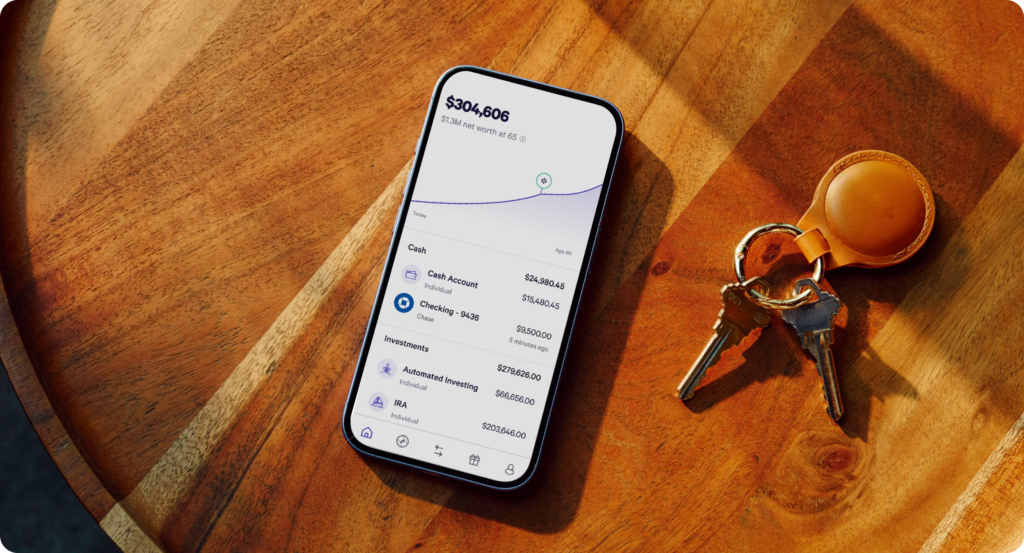
All product images shown are for illustrative purposes only.
Product images include Wealthfront’s free, software-based financial planning tool, Path, which helps users optimize their finances to meet certain goals. The information provided is not investment advice or performance. Users should not rely on this information as a basis of investment, financial, or tax planning decisions. Visit Wealthfront.com/planning for details.
Investment management and advisory services are provided by Wealthfront Advisers LLC, an SEC-registered investment adviser, and financial planning tools are provided by Wealthfront Software LLC. Brokerage products and services are offered by Wealthfront Brokerage LLC, member FINRA/SIPC. Mortgage products are offered by Wealthfront Home Lending LLC, NMLS 2358115. Equal Housing Opportunity.