

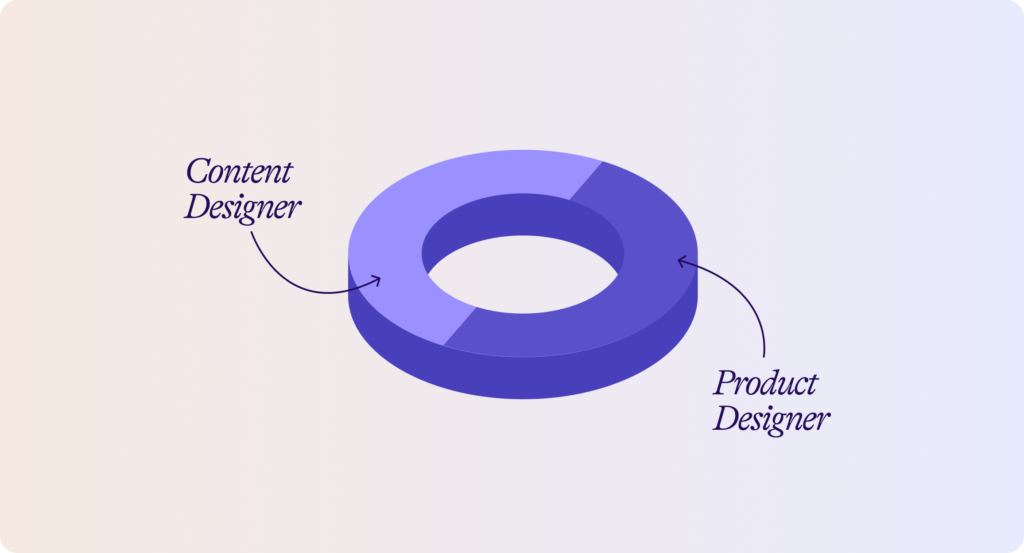
One content designer to one product designer. How did you make the case for that?
Angel Steger: I inherited it. We work in highly regulated spaces. What you say and how you say it is either safe for the company or not. It’s the client experience. The ability to craft the message in a way that lands for clarity and control. Are they able to take in the information with a certain degree of emotional calmness? Can we prevent them from inadvertently doing something that’s self-sabotaging? Are they able to consider all possibilities for themselves? In wanting to move quickly, we need to make sure we have folks that have time to do the revisions and work with XFN to shape the experience. There’s a level of complexity to the products we develop. If content design is working with 5 other teams, your ability to deeply understand one thing is compromised.
You may have inherited the ratio, but did you ever have to defend it?
Angel Steger: The value was understood before I came. Content design works closely with legal and compliance and is often the primary touchpoint.
Patrick Mankins: Content design is the second design function we hired because there are so many complex ideas we have to help people understand to make good and confident decisions.
Patrick Mankins is a Design Director at Wealthfront and the most tenured designer at the company with 9 years of colorful anecdotes. He remembers a time before the ratio.
I pitch our PDs (product designers) on this ratio. I really believe this has a profound impact on how we work and what we’re able to do. I see content design as fundamental to experience design. I was doing it before the ratio.
What were some of the projects you had to take on in absence of CD?
Patrick Mankins: The way we round, truncate, or display full numbers out to the cent has such a critical impact on our experience that I wrote a content guide for this back before we had the ratio. I remember collaborating with one of our most creative lawyers to turn a disclosure into an FAQ.
That’s a lot on top of your other design work. What was it like when you got more content support?
Patrick Mankins: It’s so nice to have a dedicated designer who is completely focused on that perspective from the start versus, “Come up with a content solution for this profoundly broken UX.” If you're a thoughtful enough designer, sooner or later, you're going to find yourself saying, “I know there’s a problem here, and I don’t have the tools to adequately solve it.” You can say the same thing about early engineering engagement. If you don’t have eng thinking about the user and business outcome, you’re abandoning many potential paths and end up with an inferior solution.
What you and Angel are touching on goes beyond managing risk with legal and compliance.
Angel Steger: Thinking through a lot of products involves detailed setup flows, the ordering of what’s the right way to bring someone through this experience. Some product designers are intuitive that way, but great content designers can think through how someone’s going to be feeling and how they move across this journey. What's the right way to meet people in terms of how we want them to feel? How does language support them? How do we keep them on an even keel or make something less scary and more approachable?
Patrick Mankins: We’re building a consumer app so the experience needs to be inviting and approachable, but at the same time, we can’t be trivializing or dumbing things down. What are the concepts and narrative that we’re dealing with here and how can we clearly explain them? Those questions are core to content design.
Angel Steger: People are making decisions that can feel very final—you’re getting a mortgage, investing your money. These are pretty momentous things for people. Great content shepherds people through that. Not every business has moments where the clients need to engage. In social media, for example, UX writing isn’t super prominent. It’s a great frame for user-generated content to shine through. In our case, we’re almost in conversation with the client and support them through these nerve-wracking and permanent-feeling processes. We want them to understand that finances aren’t for other people—they’re for you. You can do it. You understand what’s going on and feel empowered and have the confidence that you're making the right decisions for you.
How does the work of guiding decisions and managing risk translate into the fundamental structure of the product experience?
Sonya Hong Spowage: You’re creating the scaffolding. Clear concepts, compelling messaging, and terminology that’s aligned to your target audience are really key pieces to get right, in addition to clean and simple designs.
Sonya is a content designer who came to us from Shopify 3 years ago. Before that, she was at Airbnb. She’s experienced both ends of the ratio spectrum, from supporting 8 product designers as more of a consultant, to closely partnering with one or two product designers in an embedded model.
A lot of people can recognize when something isn’t clearly explained, but few have mastered the ability to clearly and effectively explain something within the constraints of the design system—and maintain that level of oversight across the entire product experience. Designing for simplicity and understanding is just as difficult to do through language as it is to do through visuals. I think you need equal effort in it. I can come up with a great narrative, but a designer has a familiar understanding of the components and how to lay that narrative across screens.
It’s a partnership.
Angel Steger: UI and words are two different ways to sculpt an experience. You have a push-pull dynamic between two equal partners. We have a live dynamic—we’re not throwing something over the wall, putting together strings and throwing it back over the wall.
You hear terms like “consultant” and “waterfall” to describe the assembly line-style of UX design that happens at so many companies—a style that this group unanimously agrees is not the best way to do work, so what is the best way? How do you like this relationship between content and product design to function?
Sonya Hong Spowage: The most flattering thing you can hear as a CD is another designer sees you as just another designer. That captures the kind of collaboration I strive for. An equal relationship where both perspectives are valued, where we’re comfortable exploring different ideas and directions, effective at resolving disagreement, and aligned going into reviews.
What about you, Megan? What does your design relationship and collaboration look like?
Megan Pluskis: I can ask questions and poke about the interaction and they can do the same for content. There is no “Stay in your lane. You can’t touch this.” It’s having that level of comfort and making both of your areas of expertise better. You both are collectively creating this. It’s about the different perspectives and fresh eyes, but also the comfort level of having this one partner that you have and work with and it’s a safe space. They can ask about your work and they’re not commenting on you, rather, the work.
Megan has been a content designer at Wealthfront for 4 years. She’s all too familiar with the “stay in your lane” mentality. In her previous roles, where “content design” was known as “content strategy,” the UI wasn’t the only thing that had a container around it.
“Content strategy” wasn’t considered design. You put the words in the boxes. Do what you’re allowed to do in your function. A lot of requests started with “Here’s the wireframe, put all the words into place.” It was less about “should the box be here or over there?” At Wealthfront, content can push in that direction.
Content design has had a bit of an identity crisis over the years with ever-changing titles like “Content strategy,” “UX writing,” “Content development,” etc. It’s a long-running self-branding debacle that deserves its own feature story.
Megan Pluskis: It’s a more efficient process having content involved from the start versus design being fully baked and then content comes in asking questions, causing us to go back to square one. “Who is our audience? Who are we really targeting? What’s the main thing people need to understand? What do they need to do?” The answers from a visual interaction perspective could be different than a content perspective, and aligning those answers from the get-go creates a better output for the user in the end.
Efficiency. That may sound counterintuitive to companies looking to keep headcount down in the name of savings.
Patrick Mankins: One of the benefits is it allows us to have two designers staffed on a project from the outset which pushes the quality of the thinking and ultimate solution. When you have two people with the same skillset and perspective, it can be very valuable. You get much more robust thinking and work. But having two different design perspectives, there’s less overlap. Cross-functionally, we believe it’s critical to have a team-embedded model versus a consulting model. It’s important to establish those longer-term collaborative relationships with PM and eng partners. That ongoing partnership is critical. We’re working on hard complex problems and building up context in the space is really helpful.
Angel Steger: When CD is spread across surfaces, you might get 30 minutes of their time across two weeks. You can’t work fast. You can’t deeply understand the client and business problem and make something in response. Nobody does their best work when their attention is split in so many different ways. Elsewhere, you have very capable people who end up as borderline fact- and grammar-checkers. That’s not what you want when you want a point of view. That POV trickles down to thoughtful experiences with language. If you want that, you have to set up the right working conditions to get it.
As a VP, how do you measure the ROI of this staffing decision?
Angel Steger: I don’t actively measure ROI. Those kinds of exercises feel like fishing expeditions. You either have a team that has velocity or you don’t. When you pinpoint velocity, you can see where it lives or doesn’t live. The justification is, when we don’t have that ratio, things are slower. The ROI is being able to ship things at a high bar that delights our clients and grows the business. It’s the same for any kind of design staffing. What does the company need to achieve and create for customers? What are the skills needed to do it? For some, that might be a great ratio of content designers. For others, maybe you don’t need content design. You may not need product design. It depends on what you’re doing. I’d encourage people to be intentional and not copy and paste from other companies.
Speaking of other companies, you worked in design leadership at other places, like Meta, Dropbox and Pinterest—and you were an IC sometime before that—it’s clear this isn’t something you’ve simply maintained. You’re passionate about it.
Angel Steger: I’ve worked with very different ratios. Having gotten to work with really excellent craftspeople, you can see the way great writing can change the texture of the room with its warmth, or understanding, or supportiveness in a scary moment. You might not be able to get that from the corner radius on your input fields. The boxes around things. Some product designers can have a flair for communication as well, but it’s not a universal skill or expectation in most leveling. It’s really apparent when a CD or UX writer knows, “I know you want to solve this problem using language, but what I’m telling you is: Don’t.” You can’t use content to hide an experience flaw. You need to change the experience. That real talk is really valuable. Thinking about the whole experience.
That “real talk” about words not always being the solution reminds me of a story Chris Knight shared from the creative world.
Chris Knight: A creative director once said to me—in the days of magazine ads—sometimes the best copywritten ads don’t have any words in them. The point of that is that the visual sets up the scenario or gag, and you get to the bottom right corner logo and the two play off of each other. That’s how you’re narrativizing this thing.
Chris Knight has been Wealthfront’s Executive Creative Director for 5 years and hails from acclaimed New York advertising agencies like R/GA. Once upon a time, he also worked in-house at MTV. He oversees a team of copywriters, designers, and producers on the creative team, which also ladders up to Angel. This reporting structure has the added benefit of facilitating a close collaboration between marketing and product design.
UX is a young industry. Maybe it’s starting to realize what Bill Bernbach discovered back in the 50s when he paired copywriters and art directors into teams—the art and copy pair. That’s how it was when I was in advertising. Isn’t that pretty standard?
Tim Blount: It’s an industry that defaults to the art and copy tandem. That’s all I knew when I started as an art director. I was a Flash designer and used to play around with Photoshop. I wanted to be a creative director and make ads and cool commercials. That was my foot in the door and I would write on the side—scripting, concepting, taglines. I was always jealous of my copywriter partner who got to sit back and think of the big ideas while I had to move stuff around and animate it—code banners, resize things. It felt harder to me. I made a purposeful transition to the copy side.
Tim is a Group Creative Director and has been at Wealthfront for more than 4 years. Like Chris—who he’s worked with before at other companies—he shares a pedigree of top advertising agencies like Crispin Porter + Bogusky.
Chris Knight: As a copywriter, you’re paired and joined at the hip (to an art director). You two are a duo and no one ever separates you. In some cases, you go to different agencies and get hired together.
In my experience, copy is treated very differently in advertising than content is in UX.
Tim Blount: In the ad business, the copywriters are the creative directors, generally. There are more leaders who came up from the copy side because the business is so much about persuasion and selling and you have to sell your work. Copywriters tend to be the more vocal talkers and the ones presenting. In most of tech, the designers are in more places of power. They tend to drive the presentations. They’re in the tools where the work is created.
For people who aren’t as familiar with the art and copy dynamic, can you paint a picture of how that relationship works?
Tim Blount: From an overarching level, you’re thinking through the problem through your own unique perspectives. The way it's additive is when you have these perspectives that can converge and become something bigger than one or the other. From previous experience—less so here—you’ll work on a branding exercise thinking at a really high level of big campaign taglines and territories. We have a business objective and want to express it a certain way, but want to explore creative ways to approach that. From a copy perspective, I might start writing a bunch of headlines. “This feels like something to dive into more. These two things feel separate because they hit different dimensions of the problem.” I’ll write headlines and a descriptive paragraph. A designer might approach it from a mood perspective or visual theme.
Chris Knight: The way a copywriter and designer think can play in each other’s media, but they do it from a certain perspective. One thing the copywriter does is create a sense of narrative—time that takes you from one space and thought to the next one. What design does is to craft those moments really well. Make them beautiful and express them the best they can through the references and visuals and material elements being pulled in. When those two work together—someone with that sensibility who understands the visual side—they fill in each other's gaps. “I’m not trained enough to know how to do this but you are. Help me finish this thought in the best executed way possible.”
You’re writing headlines, your partner’s exploring visuals—you’re sharing an office, going back and forth until you hit that “A-ha!” moment. Is that an accurate description?
Tim Blount: Both in the ad agency and pre-COVID time, you’d be sitting in rooms together and spitballing. That’s a big part of the job. Less so in tech.
Wealthfront embraces 100% remote work, so we do most of our collaboration virtually. Though, we do have offices in California, Washington, Texas, and New York if you’re nearby and prefer to spitball in person.
Tim Blount: Maybe you’re expressing this facet of speed or trust and different types of visuals highlight those elements. You can work in siloes, then come together and match up. “This visual theme expresses this territory really well.” You find ways to develop that into a more complete idea. It might look different from where it started as separate things, but it becomes one thing. That’s how the relationship works best. The visual is lifting part of the message we’re trying to get across, highlighting the best parts of the copy.
That’s similar to how Megan describes her collaborations on the product design side.
Megan Pluskis: We’re separate, but together. It’s diverge and converge—not a waterfall. When we’re in the ideation stage, we’re riffing. Then as the concepts firm up, it’s wireframe and structure and getting more into the nuts and bolts of the words. It’s very much an ebb and flow that’s adaptable depending on what the project is and what it requires. Sometimes the project is more content-led, sometimes more PD-led. We can adapt and flex and push in different directions. “Do we need to have this piece? Where is this sitting? Can we move this within the larger design? What if this goes here? How does this affect the flow of information?” We’re often in the same Figma—different frames where we can see what each other is working on. “Hey, I saw that, it made me think of this.” Or “I blew this up. I’m trying to illustrate my point. Just trying to show you a different way.” Our PDs are very low ego, so it’s no big deal. It’s a hard thing to have a process for because it’s very organic in a lot of ways.
The low ego thing is real. When I interviewed here a little over a year ago, I was struck by how approachable everyone was. I could see myself easily partnering with the people on my loop. To Patrick’s point earlier, the ratio may not be as strong of a selling point for PDs if they haven’t worked with content very much. Is that the case?
Megan Pluskis: It’s common in the interview process where PDs haven’t worked with CDs, or haven’t had a dedicated one. It does take a lot of openness and trust on the part of the product designer to say, “I don't know how this is going to go, but I’m open to this being a great partnership.”
How do you spot that willingness in a candidate? What are you looking for in general when you’re interviewing someone for a design role here?
Angel Steger: We look for humility. We have huge respect for people who have a high bar but are willing to talk about the ways they haven’t met their own bar. You can never reach the best execution so we ask, “Hey, if you could take this further, or based on what you learned, what would you do differently? Would you take it in a different direction?” Do they have thoughts about that without feeling defensive about it?
We have a strong crit culture, but not everyone is comfortable receiving feedback if they haven’t worked in that environment.
Angel Steger: Someone is taking time to offer you feedback and asking you to consider revisions. It’s part of the day-to-day work. No one knocks it out on the first try, and hopefully you enjoy the refinement process. People who get cagey or defensive spend all their time defending. They’re living a narrative in their head—“What does this say about me?” You could be thinking about business and customer problems. They’re too busy looking in the mirror while driving. Ultimately, that will show up in the work itself. People who get in their head about feedback, it’s more work for their manager and team because everyone has to be met with that emotional noise.
It creates insecurity within the team, rather than the “safe space” that Megan mentioned earlier. Psychological safety is a precious resource in this industry, particularly post-COVID and in the age of AI where we’ve seen companies make disruptive staffing changes.
Tim Blount: Our overall culture and principles and feeling of having a voice in bigger discussions is something that has been really surprising and fulfilling to me coming from a place that felt more hierarchical. We’re more intentional about good ideas coming up—intentional transparency. We’re encouraged to disagree. That space is made for all voices.
It’s one thing to publish your principles in a canonical artifact, and another to actually live them. When I joined, I remained cautiously optimistic about my impressions of our culture. You’re looking for evidence that either certifies its authenticity or reveals it to be a facade. I was surprised to see a VP of Design in our weekly design crits, but Angel’s presence and participation reinforced this feeling of “We’re in this together; don’t be afraid to speak up.”
Angel Steger: When someone brings something that feels lopsided, being helpful and constructive goes a long way. Especially where people come from environments where it’s highly political—someone on your team who’s not doing well is a threat to your success. People remember that for years. It scars people, that negative relationship experience. You had a bad relationship for one year. You need a good one for 5 years to balance that out. You never know what kind of scarring exists until people share it with you. In leadership, you try to give people courage to step in the pool even if one toe at a time. When people come to our company, we set them up with small projects that are lower risk. We allow them to focus on building relationships and context before proving this wealth of skills.
This place felt like rehab after my prior experiences. I had the “Sunday scaries” for years before coming here, and now, the prospect of Monday is met with serenity. No storm clouds gathering and crackling thunder in the distance.
Angel Steger: I’ve heard people say that from time to time. It’s very enjoyable for me here, personally. I’ll give you an analogy: I have sleep apnea and sleep with a CPAP machine that you have to get used to. You wear this horrible, unattractive mask that pumps you up with air. It was my first time falling asleep with the machine, and the next day, I woke up and felt nothing. How can you feel nothing? What was I feeling? It was the first time I had a good night's sleep. I’m not tired, achey, and sore. There was lightness going forward into my day. That’s what it feels like when you work in an environment that’s about the work, the business, the client. Smart people that work well with each other and trust each other. It’s what you don’t feel when you’re not carrying the baggage of working with someone emotionally abusive and unstable. Whether you notice in the moment, you carry it. When you don’t feel it, that's the wonderful feeling of nothing. The healing is taking off the backpack.
I love that. Sometimes it’s what’s not there that makes the biggest difference. Patrick had his own “feeling of nothing” moment that he was recently reflecting on.
Patrick Mankins: The alignment between user and business outcomes is really profound here. It’s not something I thought about before joining Wealthfront, but I see it impacting our design team and everything we do. As designers, we’re caught in the middle when there’s a tension between outcomes, and ultimately, users lose. The company is very intentional to not put us in that position. Everyone wants to have a positive impact on the client. Leadership is really engaged and cares about the client experience and that shows up in the design.
Megan Pluskis: They’ll be commenting on your stuff. It can feel a little unnerving, but it’s also great exposure to that level of staff. It further underlines the point that the content does matter. The CEO is in product review calling out, “Is that the final copy? Is it going to say that?” You can have conversations with them and it’s reasonable.
That’s another benefit of working here. In Big Tech, there are so many layers between you and the executive team. Here, you engage with them on the regular, and they’re kind, and they care. The ratio allows us to care more too.
Megan Pluskis: People who have been elsewhere, who have been the 1:30 realize what a treat this is. You get to be proud of the work you do versus, “This is the best I can do in half an hour.” Something becomes your baby for a bit. You get to enjoy the writing, and keep that enjoyment and flow state every day.
So for all those still reading—thank you!—and thinking about applying, what do you tell them?
Megan Pluskis: You don’t have to be a financial services expert to add value here. It’s welcome primarily because our skillset is positioned to simplify and easily communicate complex information, of which finances are inherently overindexed in that space. Your end product will be better—elevated. You have a partner, so you have someone to carry the load with you. Someone to share that part of your brain. Share the burden of the work. You can focus on your area of expertise. You have another person to bounce ideas.
Chris Knight: You have someone in your foxhole with you all the time. When you as a person—a human—need to go pick up your kid, someone can cover the meeting for you and report back. In the same way that you’re helping each other solve the problem together. I often tell people, we don’t expect you to do anything great for 6 months. You have to figure out finance. We’ll help you get there, but you’ll feel dumb for a long time while you figure it out.
Who would have thought that a finance company is where I wouldn’t feel like just a number? The appetite for learning, grace to make mistakes, and investment in people and relationships are why I love working here, and why I wanted to write this piece.
Disclosures: The information contained in this communication is provided for general informational purposes only.
Investment management and advisory services are provided by Wealthfront Advisers LLC, an SEC-registered investment adviser, and brokerage related products are provided by Wealthfront Brokerage, a Member of FINRA/SIPC. Financial planning tools are provided by Wealthfront Software LLC. © 2026 Wealthfront Corporation.